
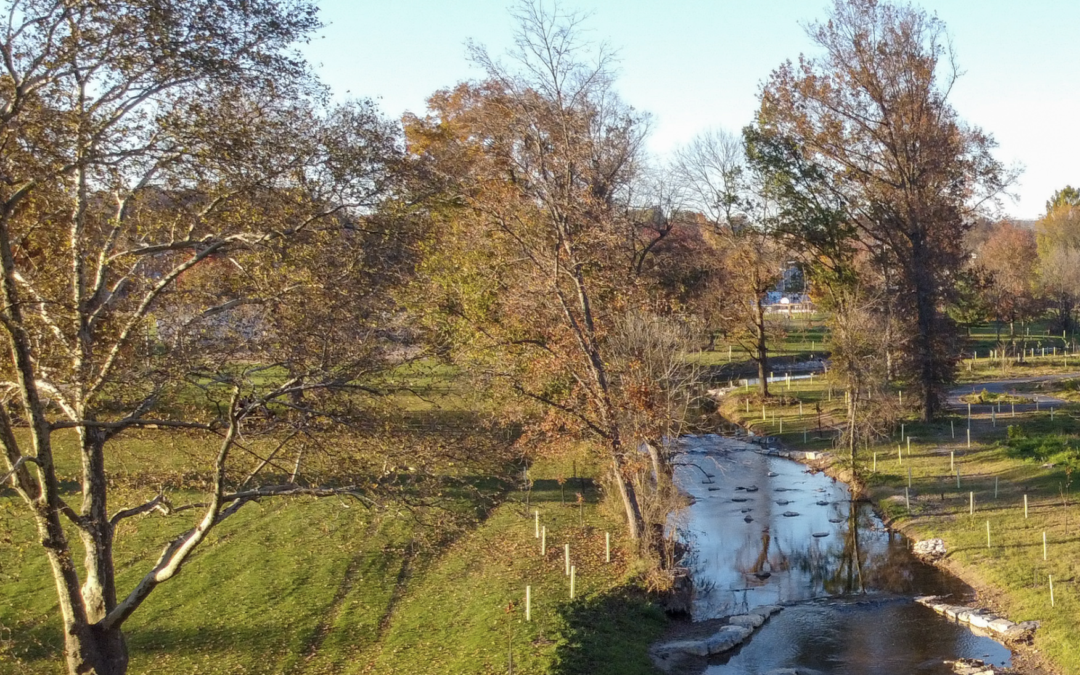
A road shoulder that crumbles a little more after each storm, a bridge abutment that seems to sit higher than it used to, a culvert that backs up whenever the nearby creek rises: These are often signs that a stream itself has changed from its natural state.
Pennsylvania has about 86,000 miles of streams and rivers, second only to Alaska, so plenty of roads and bridges sit close to moving water. Stream restoration provides a permanent solution for those channels causing damage instead of repeatedly patching with temporary solutions.
How Does an Unstable Stream Damage Roads & Bridges?
An unstable stream wears away the ground that infrastructure depends on. Bank erosion undercuts road edges and bridge approaches, and a channel that shifts sideways can press against an abutment or pier. Bed lowering, where a streambed drops over time, exposes more of a bridge’s foundations to moving water.
Engineers call the resulting loss of soil around a foundation “scour,” and the USDA Forest Service, citing FHWA guidance, calls it the most common cause of highway bridge failure in the United States.
Debris jams add risk too. Ice or debris striking a pier or abutment can dislodge bridge elements, and a crossing choked with logs has less room to pass high water, which makes flooding over the roadway more likely.
What Does Stream Restoration Do to Protect Infrastructure?
It stabilizes banks, steadies the channel, and, where the site allows, floodplain restoration gives high water room to spread out. Flyway’s stream restoration methods include cross vanes, J-hooks, and log vanes, which are rock or log structures that redirect stream flow away from an eroding bank and toward the center of the channel. Where erosion is most severe near infrastructure, imbricated riprap or stacked boulder walls hold the bank in place. Where room allows, grading more gradual slopes and planting lets roots help do the holding.
Floodplain relief addresses a different cause. In much of the Mid-Atlantic, streams cut down through old sediment deposits, leaving steep banks and a channel cut off from its floodplain. Flyway’s Fox Run project in Dover Township, part of a plan to convert a former golf course into a township park, aimed to restore about 3,440 lineal feet of stream channel by removing legacy sediments, alongside providing stormwater management facilities for the park. The Pennsylvania DEP favors restoration over dredging, which can lead to rapid sediment deposition, channel instability, and more bank erosion.
What Should Property Owners & Municipalities Know Before Starting a Project?
When considering stream restoration, plan for the permitting process early. In Pennsylvania, bank stabilization and stream crossings generally require a Chapter 105 permit from the DEP, and many bank projects qualify for a General Permit such as GP-3. Projects that don’t qualify need a more involved joint permit, and most work in state waters also needs federal authorization. Permitting can be a tedious process, but a consultation with Flyway’s team of experts can help you navigate through it.
Talk to Flyway Before You Start
If a stream is threatening a road, bridge, culvert, or property you’re responsible for, contact Flyway Excavating before starting your stream restoration project, or to talk through your options. Flyway has more than 30 years of experience in the Mid-Atlantic and has worked with municipalities, conservation districts, private landowners, others, providing waterway services including stream and wetland restoration, dam removal or rehabilitation, and bridge and culvert construction and maintenance.